The first was the Ethiopian Millennium Calendar, printed for 2007/2008, marking the turn of the year 2000 in the Ethiopian reckoning. Twenty editions later it is still built around the thing that started it: twelve months of thirty days, a thirteenth month of five, and a new year that arrives on 11 September.
A calendar that became a Passion
The production of the calendar each year has been a labour of love. It started as a fascination with the Ethiopian calendar and it has become a passion (ask my colleagues!). The calendar is essentially a Julian calendar: twelve months of thirty days each, followed by Pagume, a thirteenth month of five days, or six in a leap year. Simple arithmetic, but its anything but simple, and has given me a window into Ethiopian culture that keeps opening wider the longer you look through it.
Chief among the curiosities is where the year begins. New Year falls on 11 September, or the 12th in a leap year. The reason reaches back to the ancient Egyptian calendar, which began with the inundation of the Nile in late August, itself caused by the Kremt rains falling on the Ethiopian highlands. A neat circle: the flood that set the Egyptian year running was Ethiopian rain. Over several millennia the slow drift of the calendar against the solar year has slipped that date back by about two weeks, which is how late August became 11 September.
How the Egyptian reckoning reached Ethiopia is a matter of church history. The ancient civil calendar was taken over by the Coptic church in Egypt, which kept its thirteen months and used them to fix the feasts and the fasts. Since the start of Christianity in Ethiopia the Patriarch of the Ethiopian church was appointed from Alexandria, and back in Axumite times he must have bought the calendar with him. Ethiopia kept the structure and gave the months their Ge'ez names, Meskerem through to Pagume, counting the years from its own era of the Incarnation, seven to eight years behind the Western count.

Two calendars on one page
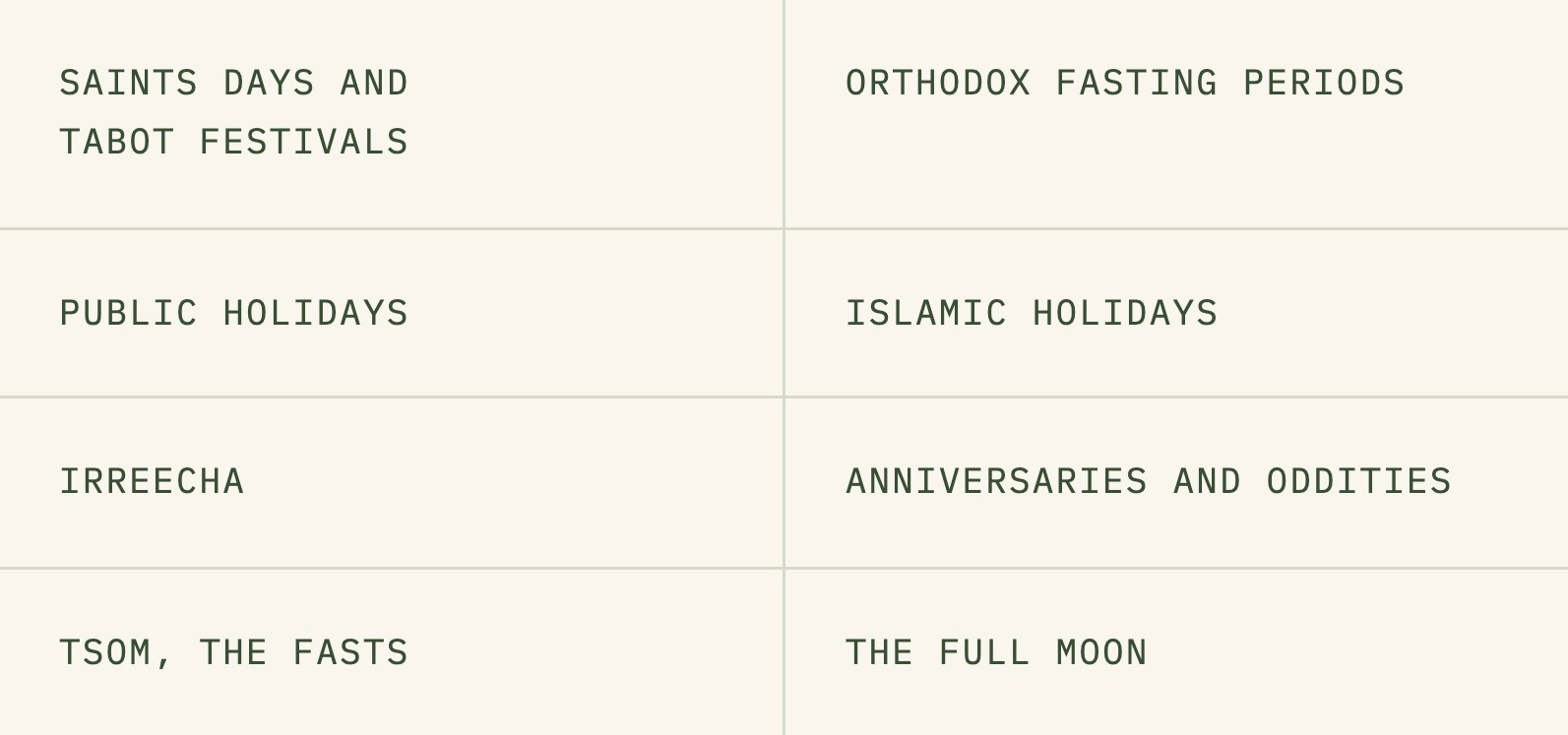
The calendar, in fusing the western and eastern, shows all the wonderful daily happenings in the Orthodox calendar: the saints days and special festivals when tabots are paraded out, the fasting periods, public holidays, and the occasional oddity like the anniversary of the Queen of Sheba's death, coming up on 21 September.
Add to that the Islamic holidays that are very much part of the interwoven Ethiopian culture, and the Oromo celebration of Irreecha, and you can see why this is such an invaluable tool for anyone wanting to understand what is happening in Ethiopia.
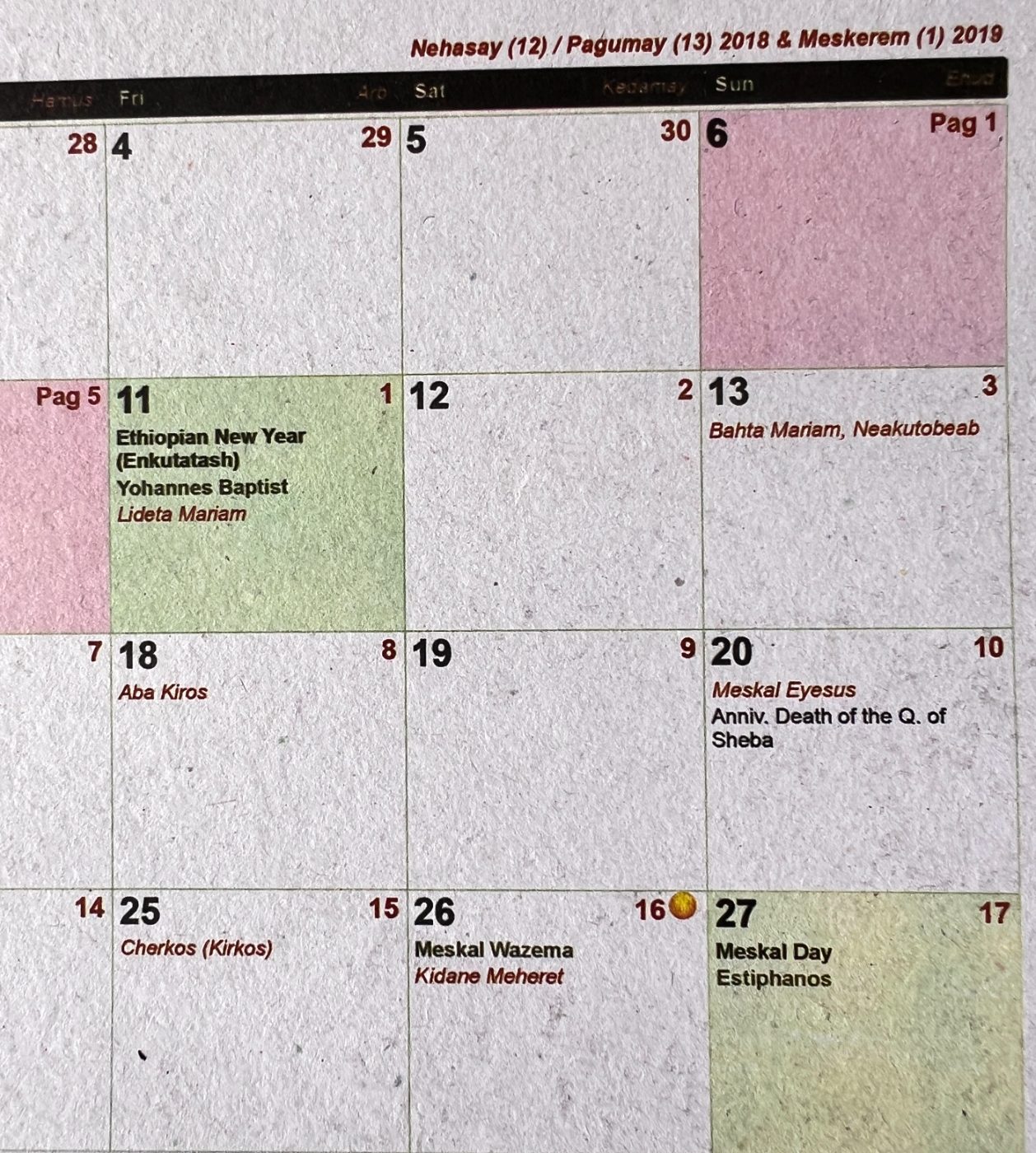
Here the grid of the calendar showing each cell carrying both dates, the weekday in Amharic and English, and the day's commemorations. 11 September is Enkutatash, Ethiopian New Year.
The diary version
For those looking for a diary version to carry with them and write notes in, the A5 format runs a week to a page with over 53 photographs. It is packed with additional information on individual saints. Find out who Teklahaimanot was, or the nature-loving saint commonly called Abo, and read more details about the celebrations going on.
Pages are included to give you some often forgotten facts about coffee, or the mystery of the Sistum.
This diary neatly leads you into next year, ending conveniently on 12 September 2027, which will be next year's New Year's Day, a leap year.
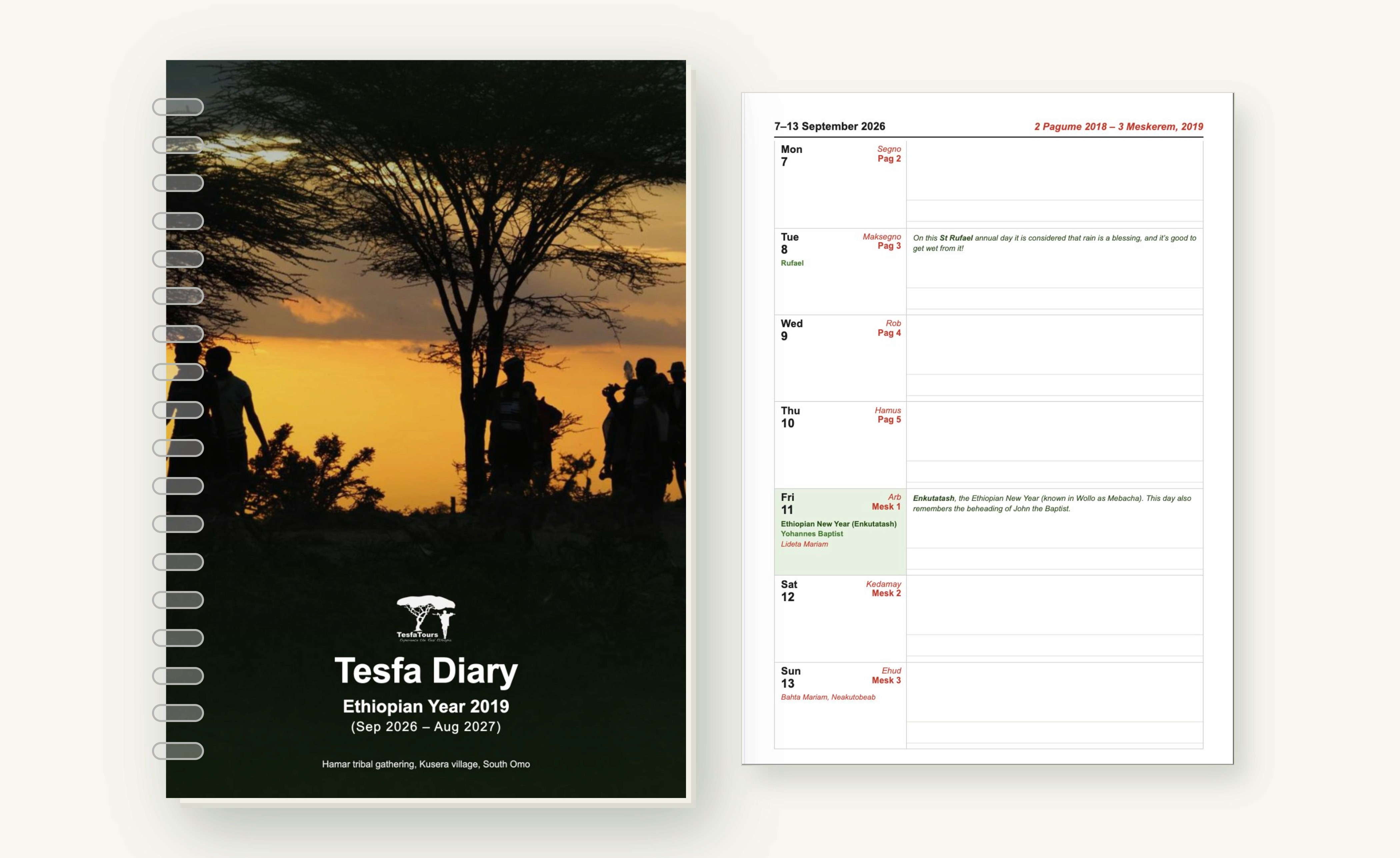
Mock-up of the A5 diary with side wire binding, and a week to a page inside. 7 to 13 September 2026 runs from 2 Pagume 2018 into 3 Meskerem 2019, with the Amharic weekday, the saints of the day, and a note on what each one marks. After a small delay at the printers it will be available by 18 September.
Format - A5, a week to a page
Photographs: Over 53 from across Ethiopia
In addition to the calendar information: - More details on saints and their feast days, little known information about the origins of coffee, Ethiopian mysteries, and a map of tourist sites.
From the Millennium to now
The first edition marked the Ethiopian Millennium: the turn from 1999 to 2000 in the Ethiopian reckoning, which fell in September 2007 by the Gregorian count. It went out as the Ethiopian Millennium Calendar 2007-2008, made for the community-based tourism work in Meket Woreda, North Wollo. It seemed the right year to put two calendars side by side and let people see the difference for themselves. We have printed one every year since.
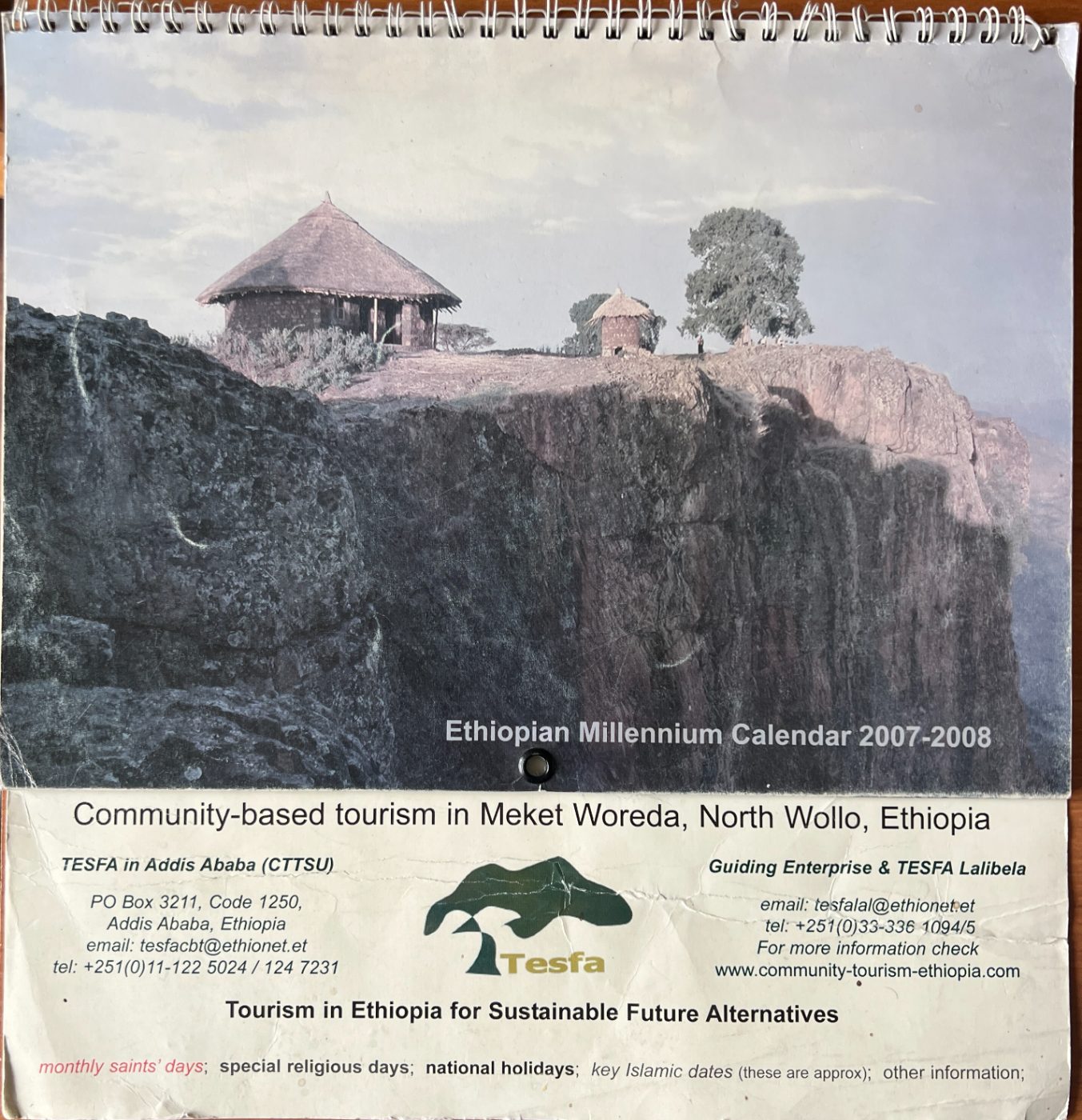
The first Tesfa Calendar, 20 years old!
This year's edition has been in design over the past few months. Now on recycled paper for the last few years.